How does drilling solid control system work
The drilling solid control system removes harmful solids from drilling fluid to ensure the smooth and efficient progress of drilling work.
The drilling solid control system is not a single piece of equipment, but an integrated system composed of multiple stages of separation equipment, auxiliary devices and control systems, working together to achieve progressive separation of solids from coarse to fine.
The Core Working Principle: Progressive Separation from Coarse to Fine
The core design philosophy of the solid control system is to remove solid particles in the order of descending particle size.This design not only ensures separation efficiency but also prevents large particles from breaking down into smaller, harder-to-remove particles during the separation process, thereby reducing the load on subsequent equipment and extending the service life of the system.
Detailed Working Process of Each Component
The complete solid control system usually includes five stages of purification equipment (adjustable according to well conditions) and a series of auxiliary devices.
- Shale Shaker – The First Line of Defense
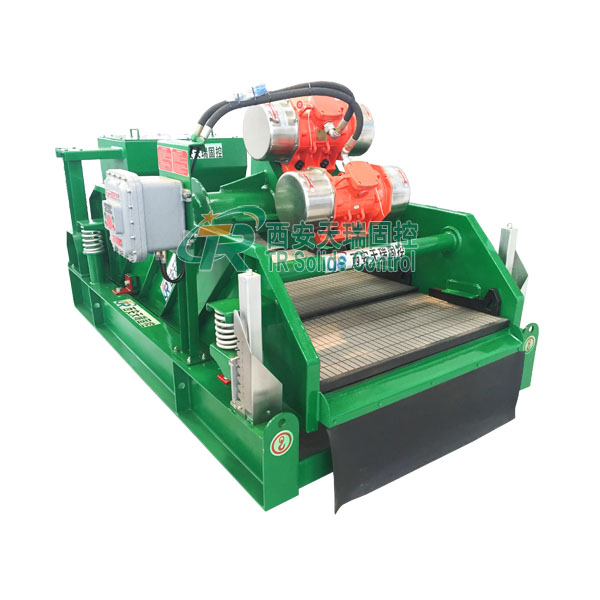
The shale shaker is responsible for removing large drilled cuttings with a particle size greater than 75μm.Its working principle: the drilling fluid onto the vibrating screen deck, and the vibrator drives the screen,making the drilling fluid perform a motion on the screen.The drilling fluid containing fine particles passes through the screen mesh and flows to the next stage of equipment, while large particles of cuttings move along the screen to the slag discharge port and are discharged, completing the initial coarse purification.
- Vacuum Degasser – Removing Harmful Gases
The vacuum degasser is specially used to remove entrained and dissolved gases from the drilling fluid.Its working principle:Under low pressure, the bubbles in drilling fluid expand and break, and the gas is sucked out by the vacuum pump and discharged (or recovered). The degassed drilling fluid is then discharged by the centrifugal pump and enters the next stage of purification.
- Desander – Removing Sand-Grade Solids
The desander is composed of sand pumps, hydrocyclones and underflow collection tanks.The sand pump sends the treated drilling fluid into the hydrocyclone.The drilling fluid rotates at high speed along the wall of the cyclone, generating a strong centrifugal force.The dense sand-grade particles are thrown to the wall under the action of centrifugal force, move downward along the wall, and are discharged from the underflow port; the drilling fluid with low density gathers toward the central axis, forms an upward “inner spiral flow”, and is discharged from the overflow port into the next stage of desilter.
- Desilter – Capturing Mud-Grade Fine Particles
The desilter is similar in structure to the desander.Its working principle is also based on centrifugal sedimentation, but the sand pump delivers higher pressure.The mud-grade particles are discharged from the underflow under the action of strong centrifugal force,and the solid content of the drilling fluid discharged from the overflow port can be reduced to less than 5%, basically meeting the requirements of drilling circulation.
- Centrifuge – The Precision Treatment Terminal
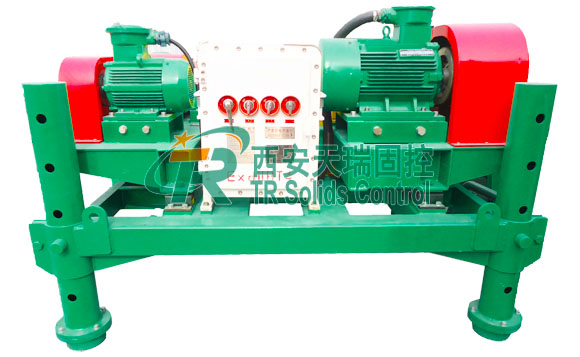
The centrifuge is the equipment with the highest purification accuracy in the solid control system, which can remove ultra-fine particles.The commonly used decanter centrifuge in drilling operations is composed of a drum and a screw pusher.After the drilling fluid enters the drum from the feed port, under the action of centrifugal force generated by high-speed rotation, the solid particles quickly settle to the inner wall of the drum, and the screw pusher pushes the settled solids to the slag discharge port at the small end of the drum for discharge; the clarified drilling fluid is discharged from the overflow port at the large end of the drum, completing the “precision solid-liquid separation”.
- Auxiliary Devices: Ensuring Stable Operation of the System
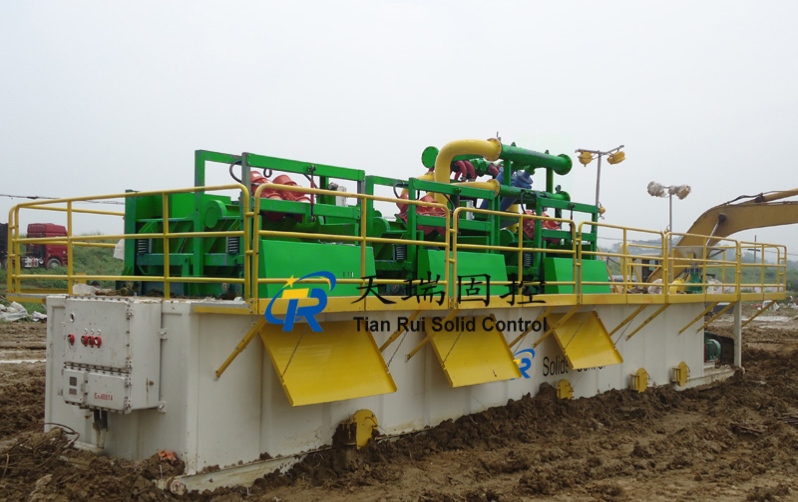
In addition to the five-stage purification equipment, the solid control system also includes a series of auxiliary devices.The mud agitator prevents solid particles from settling and stratifying in the tank by driving the impeller to rotate, maintaining the uniform suspension of drilling fluid and promoting the uniform mixing of chemical treatment agents and drilling fluid. The mud tank is divided into multiple compartments, which are used to store, mix and circulate drilling fluid, providing a stable working platform for each purification equipment. Sand pumps and shear pumps provide power for the circulation of drilling fluid and the mixing of chemical agents, ensuring the smooth progress of the entire purification process.
Key Functions and Significance of the Solid Control System
The normal operation of the drilling solid control system is crucial to drilling operations.First, it maintains the stability of drilling fluid performance. Second, it reduces the wear of solids on drill bits, drilling tools and pumps, significantly extending the service life of key equipment. Third, it recycles drilling fluid,reduces drilling fluid treatment costs, and achieves resource recycling.Fourth, it reduces harmful solids in waste drilling fluid, reduces environmental pollution risks.
In short, the drilling solid control system is an indispensable core equipment in modern drilling engineering,and ensuring that drilling operations are carried out safely, efficiently and economically.